

REVIEW: “The Last House”
Courtesy of Netflix
The Last House is the sort of movie that gives streaming originals a bad name. It takes a genuinely intriguing premise, one that could have made for a claustrophobic survival thriller, but instead turns it into a slow and frustrating watch. There’s a good movie buried somewhere inside The Last House, but it’s even more trapped than the family at its center.
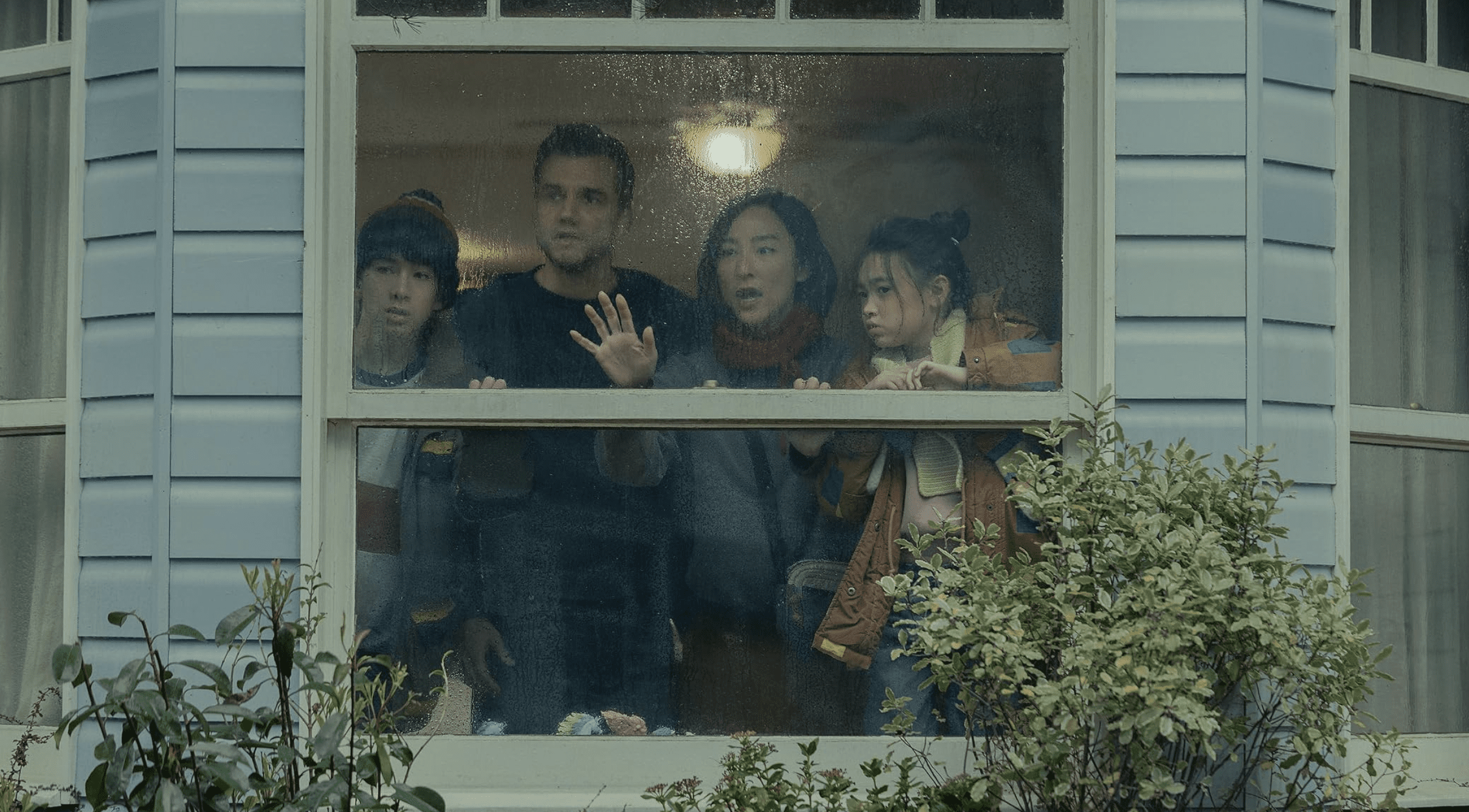
The movie focuses on the Delgados: Jason (Wagner Moura), an unemployed engineer; his wife, Ann (Greta Lee); and their preteen kids, Graham (Noah Alexander Sosnowski) and Ruth (Riley Chung). They live in a quaint Seattle suburb and are gearing up for the holidays when a torrential rainstorm rolls in. Soon, they discover that all the doors and windows in their house are stuck shut. More alarmingly, even their neighbors seem sealed inside their own homes too. Not long after, communication with the outside world cuts off, and there are signs that something monstrous, or possibly otherworldly, is lurking outside.
From there, the movie turns into a test of whether the family can stay together and survive. At first, they stay positive by watching movies, cooking, playing board games, and reconnecting in analog ways. But as days become weeks, then months, and eventually years, their resources dwindle, the kids get older, and the family’s closeness gives way to fear and desperation. One thing viewers should know: as the years pass and rations grow scarce, the family’s pets become part of the survival equation. No need to go into details; just consider yourself warned.

For most of its runtime, the movie plays like a slow-burn chamber piece, moving at a glacial pace with little escalation. A family watching years slip away while trapped inside four walls should be terrifying, but the script settles into a loop: the family argues, something strange happens outside, the kids get scared, the parents yell, and then it all starts again. Although years are supposed to pass, the movie doesn’t really make you feel that passage of time. The one element that helps show time marching on is Kevin Jenkins’ production design, which is a highlight of the movie. The house changes along with the family: walls crack, floors get damaged, rooms are repurposed, and a cozy suburban home slowly becomes a battered bunker. The house’s physical decay tells more of the story than most of the script.
Unfortunately, the family inside the house doesn’t feel believable. At no point do the Delgados feel like an actual family. They seem more like four strangers thrown together. This problem gets worse when the child actors are replaced by teen actors halfway through the movie. Graham and Ruth become irritating, and their rebellious behavior makes less sense given the threat right outside their front door. Jason and Ann aren’t much better; they talk about unity while constantly working against each other, and Moura and Lee don’t have the chemistry to make their marriage feel real. Moura, one of the best actors working today, brings flashes of nuance to Jason, but Lee feels badly miscast as Ann, and her performance exposes the limits of her range. Both actors spend too much of the movie yelling and panicking, which makes their performances more annoying than engaging.
The screenplay doesn’t do the cast any favors. It’s loaded with heavy-handed narration about such weighty themes as climate change, humanity’s relationship with nature, and isolation. It’s also unmistakably a COVID-coded movie about people suddenly trapped at home and forced to adapt to a frighteningly new normal. Any one of these ideas could have carried a movie, but The Last House barely explores them. Things fall apart even further when monstrous sea creatures emerge from the endless rain. They’re supposed to be mysterious or scary, but the more they appear, the less interesting they become.

This brings up the movie’s biggest issue: it can’t decide what kind of story it wants to tell. Is it a horror movie? A survival thriller? A supernatural mystery? An environmental parable? Apparently, the answer is all of the above because it tries to be all of these at once. After spending most of its runtime as a slow drama, it abruptly shifts into wild action, with the Delgados fighting sea monsters as the movie races toward a rushed conclusion. The tonal whiplash shows director Louis Leterrier’s limitations. Known for action movies like The Transporter, The Incredible Hulk, and Fast X, he seems oddly uncomfortable with the smaller, character-driven material. His direction feels flat and never builds the sustained tension needed to make the situation unsettling. When the movie shifts into what should be his wheelhouse, the action is surprisingly confusing and messy, as if the film is trying to make up for an hour of inactivity by throwing everything at the screen at once.
As the action gets more chaotic, the movie’s logic falls apart. Audiences can accept crazy premises if a movie sets clear rules and sticks to them, but The Last House rewrites its rules whenever the plot gets stuck. The more you think about how the house is sealed off, how the creatures function, or why certain things happen, the less sense any of it makes, which is a big problem for a movie built around a mystery. The ending is especially frustrating. After almost two hours of raising questions, the movie provides no real answers or closure. Instead, it hints at a sequel, which is an impressively bold and optimistic move for a movie this bad.
In the end, The Last House has a good idea and some strong visuals that could have made for a gripping survival thriller. But it lacks believable characters, strong writing, and a clear story. The Delgados spend years trying to escape their house, but most viewers will probably want to leave long before the credits roll.
The Last House is currently available to stream on Netflix.